|
|
|
|
|
|
|
|
 |
|
Regional blocks like peripheral nerve block (PNB), adductor canal block (ACB), interspace between the popliteal artery and capsule of the posterior knee block (iPACK), and genicular nerve block (GNB) are all commonly used to block nerve transmission. Individually, they target only certain nerves – but together, are they more effective?
132 patients undergoing primary, unilateral TKA were included in this 3-arm, triple-blinded trial. Patients were randomized to receive either an iPACK block (n=44), GNB (n=44) or a combination of the two (n=44) alongside combined spinal anesthesia and continuous ACB. The primary outcome of interest was postoperative knee pain during movement, measured using a visual analog scale (VAS).
-
A significant improvement in knee pain and posterior knee pain at rest and during movement was found for all groups at 4, 8, and 12 hours, as well as for VAS knee pain during movement at 24 hours, and VAS knee pain at rest and on movement and VAS posterior knee pain on movement at 48 hours.
-
However, only the differences in VAS knee pain scores during movement at 4- and 8-hours were found to be clinically significant for the iPACK+GNB group, when compared with the iPACK group.
-
No other clinically significant differences were found for all secondary outcomes.
Bottom line. In patients undergoing TKA, adding GNB to an iPACK block appears to be more clinically effective in the short-term reduction of knee pain compared to iPACK alone. However, it did not appear to be more effective than GNB.
Read the full ACE Report on this study here. |
 |
|
|
|
|
 |
|
Peri-operative bleeding in non-cardiac surgeries can lead to serious complications, including death. Tranexamic acid is commonly used to reduce bleeding during surgery, however, there is limited evidence of its effectiveness and safety in non-cardiac surgeries. The POISE-3 study, published in the New England Journal of Medicine, aimed to establish whether tranexamic acid can provide a reduction in bleeding events with a level of safety that is non-inferior to placebo in patients undergoing non-cardiac surgery.
9,535 patients undergoing non-cardiac surgery were randomized to receive tranexamic acid (n=4757) or placebo (n=4778) at the start and end of surgery. The primary efficacy outcome was a composite bleeding outcome of life-threatening bleeding, major bleeding, or bleeding into a critical organ. The primary safety outcome was a composite endpoint of myocardial injury, non-hemorrhagic stroke, peripheral arterial thrombosis, or symptomatic proximal venous thromboembolism, which was tested for non-inferiority vs. placebo.
-
The results of the trial found a significantly lower rate of composite bleeding events in the tranexamic acid group vs. placebo (9.1% vs. 11.7%, p<0.001).
-
However, the non-inferiority of tranexamic acid was not established for the composite cardiovascular safety outcome (14.2% vs. 13.9%, p=0.04 [p<0.025 required for non-inferiority]).
Bottom line. Tranexamic acid administered before and after non-cardiac surgery led to a lower rate of life-threatening bleeding, major bleeding, or bleeding in a critical organ in non-cardiac surgery patients. However, tranexamic acid was unable to demonstrate non-inferiority to placebo in safety outcomes.
Read the full ACE Report on this RCT here. |
|
|
|
|
|
 |
|
“It used to be that just demonstrating interest through electives and doing any type of research was important, but now we are seeing more and more that the number and quality of research is becoming much more of an issue…and the benefits may not always be the medical students.”
~ Mohit Bhandari
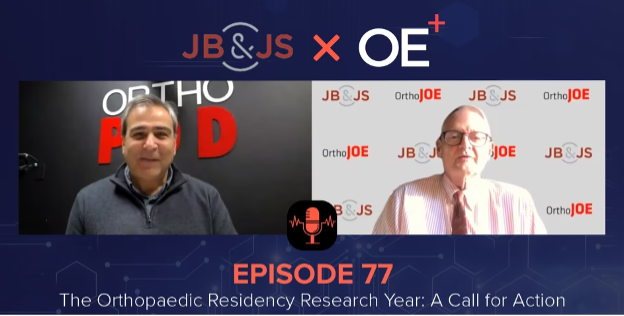
In this OrthoJoe Episode, Dr’s Marc Swiontkowski and Mohit Bhandari discuss the relatively new phenomenon of the “research year” – and who stands to benefit most from these ever-tightening research requirements for orthopaedic residency.
Watch the entire conversation here. |
|
EDITOR’S PICKS |
|
|
|
Spinal Cord Stimulation for Chronic Pain – Spinal cord stimulation is a treatment that divides opinion. Written by one of the leading academics in spinal cord stimulation research, this OE Original presents a summary of recently published multi-society guidelines for spinal cord stimulation (SCS), including how to determine good candidates for treatment. (Read) |
|
|
|
Hot Topics in Orthopaedics: Excellence, Humility, and Metacarpal Fractures – In this OrthoJoe episode, Marc and Mo discuss 2 recent articles, including (1) an OE Insights article on the importance of cultivating habits of excellence, kindness, humility, and being present and (2) a JBJS article on the treatment of metacarpal shaft fractures (Listen or Watch) |
|
|
|
|