|
|
|
|
|
|
|
|
 |
|
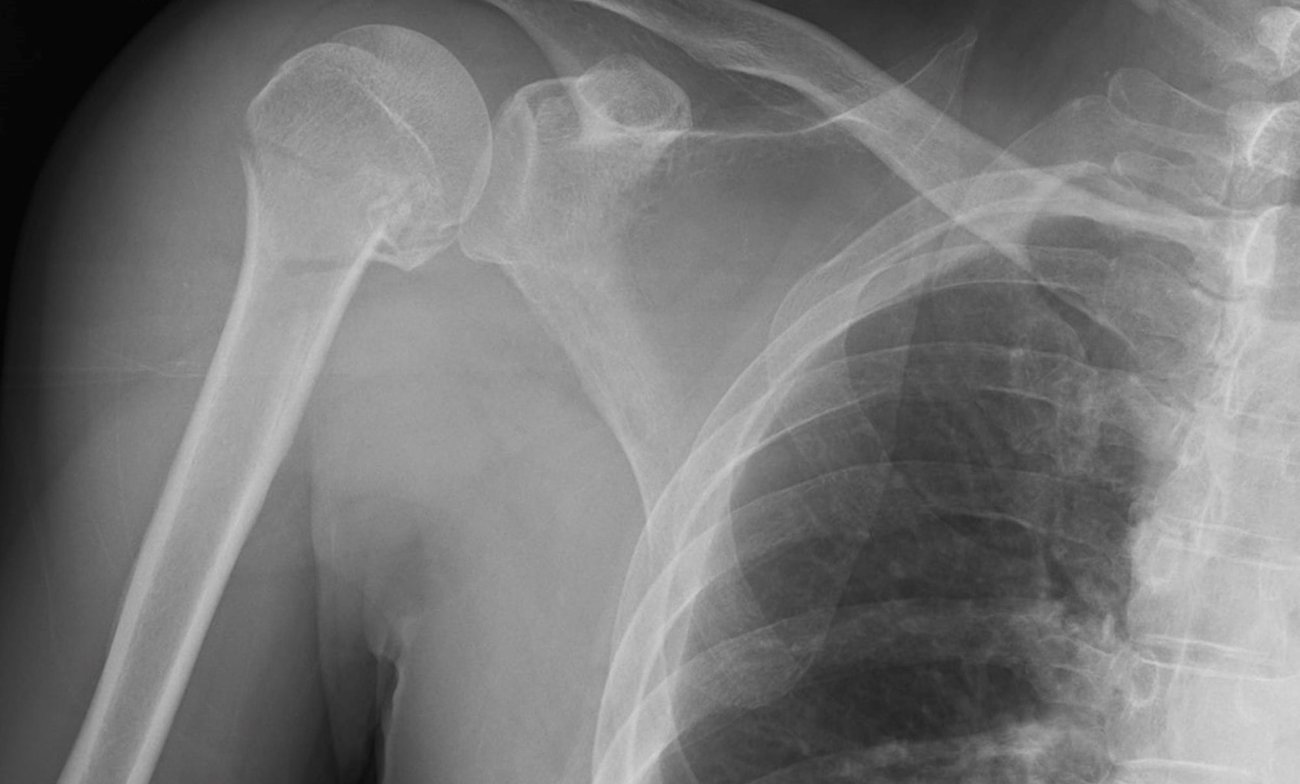
Neer 4-part proximal humerus fractures are surgically challenging, with a high risk of complications. Plate fixation, a common surgical approach for treating these types of fractures, may be supplemented with a bone graft to help increase fixation stability and healing rate. This study compared two types of grafting interventions: pectoralis major pedicle bone grafting and tricortical iliac grafting.
In this randomized controlled trial, 34 patients with Neer 4-part proximal humerus fractures were randomly assigned to receive either plate osteosynthesis with a vascularized pectoralis major graft (Group 1, n=17) or tricortical iliac grafting (Group 2, n=17). The primary outcome was reduction loss, and secondary outcomes included humeral parameters (humeral neck shaft angle, humeral head height, avascular necrosis) and functional assessments.
-
Group 1 experienced significantly less reduction loss (17.6% vs. 58.8%) and a lower incidence of humeral head avascular necrosis (5.8% vs. 29.4%) compared to group 2.
-
Patients in group 1 also demonstrated normal humeral neck-shaft angles in a higher percentage of patients and achieved satisfactory clinical and radiological results without introducing additional donor site morbidity.
-
Constant scores did not show statistically significant differences between the two interventions.
Bottom line. The use of a vascularized pectoralis major graft in plate osteosynthesis significantly reduces the risk of reduction loss and avascular necrosis of the humeral head compared with tricortical iliac grafting. Pectoralis major graft may be a valuable technique for achieving favorable clinical and radiological outcomes without imposing additional donor site morbidity.
Read the full ACE Report on this trial here. |
 |
|
|
|
|
 |
|
“In a time of increasing burnout and dropout, it has never been more important to talk about the sense of awe and wonder that is ever present in medicine today.”
– Jane Hart
There is something healing about the beauty of life – a walk with your love through a garden, hearing the echoes of your footsteps in a grand cathedral, staring at the stars on a clear summer night. These experiences can be summed up in one word: awe.
The sense of awe that surrounds the medical profession, if treasured, respected, and cultivated, can make for better and healthier doctors. And in this OE Insight, we discuss ways in which you can cultivate your own sense of awe to bring richness and meaning to both your clinical practice and your personal life.
Read the full OE Insight here.
|
|
|
|
|
|
 |
|
Chronic lower back pain (CLBP) leads to disability and severe discomfort that compromises the quality of life of patients. One of the causes of low back pain is weakened ligaments -- thus, the repair and strengthening of these ligaments may help to alleviate the back pain. Prolotherapy could achieve this: the use of osmotic agents causes cellular rupture and inflammation resulting in the release of cytokines and growth factors that may help to facilitate the repair of these damaged tissues. This study was therefore undertaken to compare the effectiveness of prolotherapy to conservative treatment in patients with CLBP.
38 patients with CLBP who were non-traumatic and unresponsive to at least 1 month of physical therapy were included in this blinded trial. Patients were randomized to receive either prolotherapy with hypertonic glucose solution (n=19) or conservative therapy (n=19). The outcomes of interest included pain intensity (Visual Analog Scale [VAS]) and functional disability (Rolland-Morris Disability Questionnaire [RMDQ]), assessed at baseline and 1, 3 and 6 months.
-
A significant improvement was observed from baseline to 6 months in both groups in terms of VAS and RMDQ scores.
-
A statistically significant difference for both scores was found only at the 3-month assessment in favor of the conservative therapy group.
Bottom line. In adult patients with CLBP, both prolotherapy and conservative treatment showed similar results after 6 months with respect to both pain and disability. However, conservative therapy provided better pain and functional outcomes at 3 months.
Check out our full ACE Report on this paper. |
|
EDITOR’S PICKS |
|
|
|
PREPARE Trial Results – In this OrthoPod, Dr Mohit Bhandari is joined by PREPARE Principal Investigators Dr. Gerard Slobogean and Dr. Sheila Sprague for a discussion on how the results are already leading to policy changes in some North American hospitals. They also discuss the unique trial protocols they used, how the trial design led to high engagement, how these results will impact future trials. (Watch) |
|
|
|
Robotic Surgery in Arthroplasty – The emergence of robotic systems has opened up a new frontier in orthopaedics. One area which is seeing extensive interest in robotic technologies is arthroplasty. In this OE Original, we used the Surgical Analytics platform to gain insight into the current and future world of robotics in arthroplasty surgery. (Read) |
|
|
|
|