|
|
|
 |
|
Presented by OrthoEvidence |
|
|
|
|
|
|
|
|
TRAUMA |
|
|
 |
|
Postoperative rehabilitation after operative fixation of proximal humerus fractures remains highly variable, with many surgeons favouring prolonged immobilization despite advances in angular-stable implant technology. Restrictive protocols may contribute to stiffness, delayed recovery, and reduced independence, particularly in elderly patients. Given the lack of consensus and conflicting recommendations in the literature, a high quality RCT was needed to determine whether early unrestricted active motion can be safely implemented without compromising functional outcomes or increasing complications.
55 patients with proximal humerus fractures were randomized to begin immediate restriction-free and assisted motion post-operation, or 4 weeks of sling immobilization with passive motion only. The primary outcomes of interest were function, quality of life, pain and patient satisfaction over a 24 month period.
-
There were no differences in functional outcomes (Constant score, DASH score) in the 24 months post-operation between the two groups, suggesting no difference in functional recovery.
-
Similarly, pain scores, patient satisfaction, and quality of life scores were not significantly different either, at all time-points.
-
9 complications were reported in the trial, with a lower rate in the early active motion group.
Bottom line. Early active motion after proximal humerus fractures resulted in similar levels of function, quality of life, pain, or satisfaction vs standard 4 week immobilization.
Read the full ACE Report on this study here.
|
 |
|
ORTHOPAEDIC NEWS |
|
|
 |
|
Medical malpractice litigation remains an unfortunate reality that most orthopaedic surgeons hope never to face—but many eventually do. Practicing as an orthopaedic surgeon in Philadelphia, a region with a high and increasing prevalence of litigation, Dr Joseph Abboud has seen firsthand how the medicolegal climate influences daily clinical decision-making and contributes to defensive medicine.
In his new JBJS Current Concepts Review, Medical Malpractice Litigation in Orthopaedic Surgery in the United States. Risk Factors, Outcomes, and Strategies for Navigating Lawsuits, Prevention, and Reform, we sought to better understand why claims occur, how they unfold, and how surgeons can protect both their patients and themselves.
Read the full article here.
By Dr Joseph Abboud and Dr Peter Boufadel | Sourced from JBJS OrthoBuzz |
|
|
OE PODCASTS |
|
|
 |
|
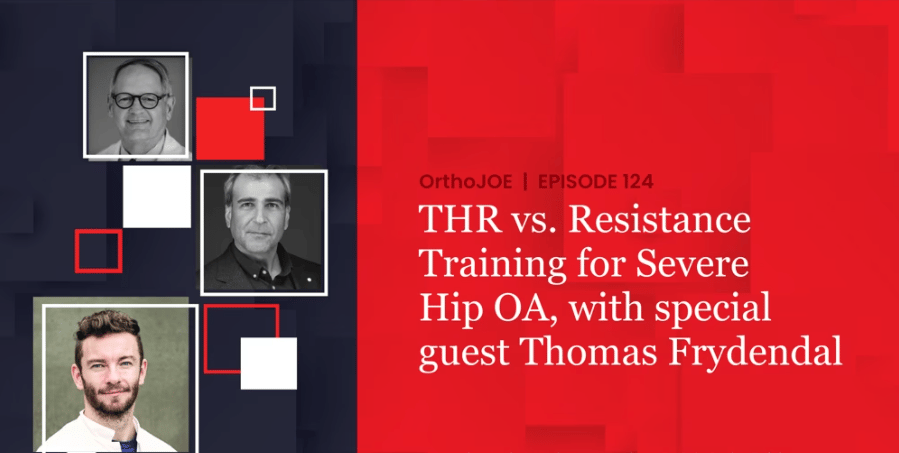
In this episode of OrthoJoe, we sat down with Dr Thomas Frydendal, a physiotherapist and researcher from Denmark who recently published a large randomized trial in the New England Journal of Medicine comparing total hip replacement and resistance training for patients over the age of 50 with severe hip osteoarthritis.
They discuss the results and challenges associated with this trial, which was part of his PhD, and his next planned trial in milder cases of osteoarthritis.
Watch the full podcast here.
|
|
LATEST ORTHOPAEDIC RESEARCH |
|
|
|
Cemented vs. Cementless Total Knee Arthroplasty: A Ten Year Follow Up – In adults undergoing primary total knee arthroplasty, does cementless fixation result in equivalent clinical outcomes and implant survivorship compared with cemented fixation at a minimum of ten years of follow-up? (Read)
(Read)
(Read)
(Read)
(Read)
(Read)
(Read)
(Read) (Read) |
|
|
|
Efficacy of 3D Release Technique & Active Release Therapy on Scapulocostal Syndrome Patients – In IT workers with scapulocostal syndrome, does the 3-dimensional release technique improve pain intensity, pain pressure threshold, craniovertebral angle, and scapular position compared with modified active release therapy after a two-week intervention period? (Read)
|
|
|
|
Comparing Anterior Cruciate Ligament Reconstruction with Allograft Versus Autograft – Do autografts result in superior clinical and functional outcomes compared with allografts in patients undergoing primary anterior cruciate ligament reconstruction? (Read)
|
|
|



